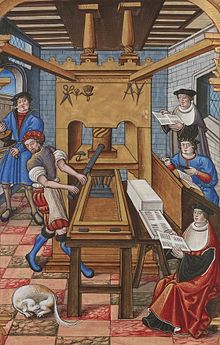
The press
The press
The use of stones to seal perhaps the oldest known form printing. Commonly used in ancient Babylon and many peoples, as a substitute for the signature and as a religious symbol, the artifacts were made of stamps and seals to print on clay, or stone with carved or engraved on the surface drawings. Stone, often in a crimped ring, was colored with pigment or clay and pressed against an elastic and ductile to achieve printing surface.
The evolution of printing from the simple method of buffer to the process of printing press seems that occurred independently at different times and in different places of the world. The books were copied by hand with pen or brush applied with ink are a notable feature of Egyptian, Greek and Roman civilizations. These manuscripts also concocted in medieval monasteries and had great value. In ancient Rome, commercial book publishers launched editions of up to 5,000 copies of certain colored manuscripts, such as the Roman poet Martial epigrams. Copy tasks were carried out by enlightened slaves.
Printing in East
Already in the second century A.D. the Chinese had developed and implemented in general the art of printing texts. As with many inventions, it was not entirely new, as the impression of drawings and images on tissue squeezed out at least a century ahead in China to printing words.
Two important factors that influenced positively the development of printing in China were the invention of paper in 105 AD and the spread of Buddhism in China. Common writing material of ancient Western world, papyrus and parchment, were not suitable for printing. The papyrus was too fragile printing surface and parchment, a thin skin tissue from freshly skinned animal, it was an expensive material. The paper, however, is quite strong and economical. Buddhist practice to make copies of prayers and sacred texts favored mechanical methods of reproduction.
The earliest known examples of Chinese printing, produced before 200 AD, were obtained based on letters and carved in relief on wooden blocks images. In 972 were printed in this way the Tripitaka, the Buddhist sacred writings consisting of over 130,000 pages. A Chinese inventor of this period went from wooden blocks to the concept of printing by movable type, ie single characters arranged in a row, as in the present techniques. However, since the Chinese language requires between 2,000 and 40,000 different characters, the ancient Chinese art that not considered useful, and abandoned the invention. Movable type, cast in molds, were independently invented by Koreans in the fourteenth century, but also considered less useful than traditional print-based blocks.
Printing in the West
The first cast metal movable type was performed in Europe by mid-fifteenth century; was printed on paper with a press. The invention does not appear to bear some relation to previous Far East: both techniques are very different in terms of detail. While the eastern printers using water-soluble inks, Western inks used from the beginning diluted oils. In the East, the prints were achieved by simply pressing the paper with a piece of wood against the inked block. The first Westerners to the Rhine Valley printers using wooden mechanical presses whose design reminded me of wine presses. The eastern printers that used movable type bound them with mud or rods through rates.
Western printers developed a technique of casting types such precision that were held together by simple pressure applied to the ends of the support page. With this system, any letter stand out a fraction of a millimeter on the other, could make the letters around it ran out of print. The development of a method to melt letters with precise dimensions is the main contribution of Western invention.
The basics of printing had been used by European textile artisans to stamp tissues, at least a century before printing on paper was invented. The art of papermaking, who came to the West during the twelfth century, spread throughout Europe during the thirteenth and fourteenth centuries. By the mid-fifteenth century, already existed role in large quantities. During the Renaissance, the rise of a prosperous and enlightened middle class increased demand for written materials. The figure of Martin Luther and the Reformation and the subsequent religious wars, depended heavily on the press and the continuous flow of print.
Johann Gutenberg, born in Mainz (Germany), is traditionally considered the inventor of the printing press in the West. The date of this invention to 1450. Some Dutch and French historians have attributed this invention to his countrymen, claiming ample evidence. However, the books of the first printer of Mainz, and in particular the issue known as the Gutenberg Bible, far surpasses in beauty and expertise to all books that supposedly preceded him. The great achievement of Gutenberg undoubtedly contributed decisively to the immediate acceptance of the printed book as a substitute for handwritten book. Books printed before 1501 are said to belong to the era of incunabula.
In the period between 1450 and 1500 over 6,000 different works were printed. The number of printers increased rapidly during those years. In Italy, for example, the first printing press was founded in Venice in 1469, and by 1500 the city had 417 printers. In 1476 one Greek grammar is printed with fully Greek typography in Milan and in Soncino Hebrew Bible was printed in 1488. In 1476 William Caxton brought the printing press to England; in Spain, Arnaldo de Brocar composed the Complutense Polyglot Bible in six volumes between 1514 and 1517 at the initiative of Cardinal Cisneros; Juan Pablos in 1539 founded a printing press in Mexico City, introducing this technique in the New World. Stephen Day, a locksmith by trade, came to Massachusetts Bay in New England in 1628 and assisted in the founding of Cambridge Press.
Printers northern European manufactured especially religious books such as bibles, psalteries and missals. Italian printers, however, consisted mainly secular books, for example, the Greek and Roman classics recently rediscovered, stories of Italian writers lay and scientific works of the Renaissance scholars. One of the first major applications of printing was the publication of pamphlets: in religious and policies of the sixteenth and seventeenth centuries struggles, pamphlets circulated profusely. The production of these materials largely occupied printers of the time. The leaflets also had a wide circulation in the Spanish colonies in America in the second half of the eighteenth century.