domingo, 10 de mayo de 2015

Other explorers

Other explorers

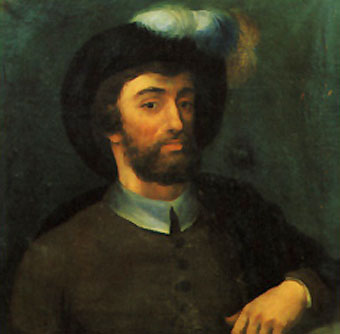
-Vasco Núñez de Balboa 


Vasco Nunez de Balboa was born in 1475 in Jerez de los Caballeros, in the Spanish region of Extremadura . His family belonged to the minor nobility Extremadura , group traditionally dedicated to war and that after the discovery of America , enlisted in the conquering ranks. His education was typical of their social status ; he became a page of Pedro Portocarrero , lord of Moguer , where he trained as a squire .

I would die in January 1519 implemented in Acla . The reason for his execution would be betrayal of Castilla gold .


-Amerigo Vespucci


The name derives from "America" Amerigo Vespucci Amerigo Vespucci, in Castilian, navigator and Florentine merchant who in 1492 went to Seville to assist in the provision of ships destined for the Indian. In 1497, his travels began in South America, of which he wrote a relationship that was to form the basis of a series of publications on travel that had taken place along the coasts of the new continent, and the title of the which generally it was the name of the traveler.

In some works, such as the cosmography of Waldenmüller, the error of considering Vespucci as the discoverer of the New World is committed and even suggested that the name of Florentine given to the continent discovered.

This error is imposed over time. So it can be said that although a repeated error does not become truth, can become accepted as the name of an entire continent.


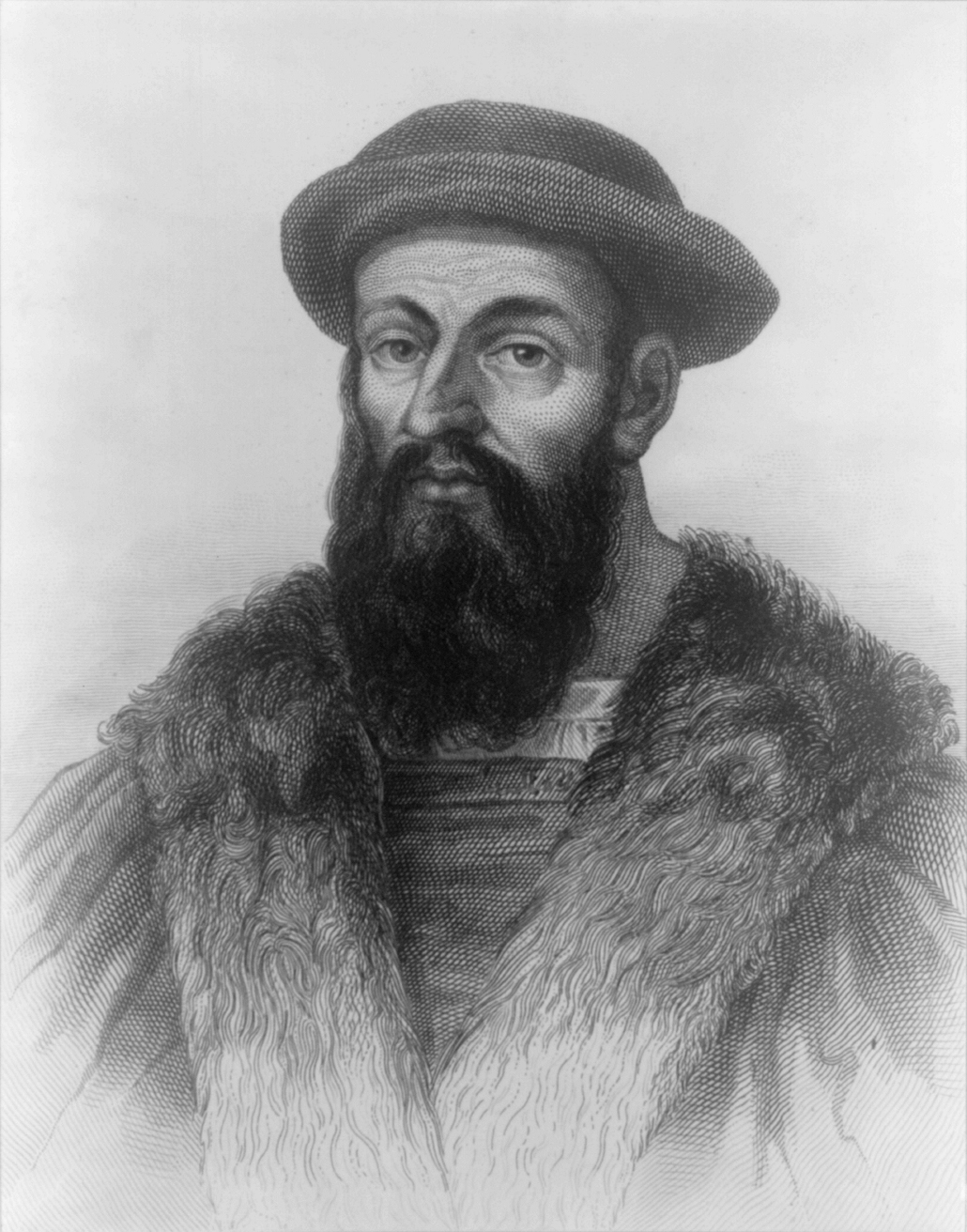
-Ferdinand  Magellan


 Magallanes belongs the glory of having found the passage from the Atlantic to the Pacific, having crossed it, discovering Oceania and the Philippines and organizing around the world who performed his own expedition, he led after his death by Sebastián Elcano.

After spending many adventures in the South Seas, he managed to reach Spanish soil, was received by Charles V, who ennobled him with a coat of arms, which contained, on a globe, the famous inscription Primus circumdedistime.


-Juan Sebastián Elcano


Spanish navigator who completed the first circumnavigation of the world (Guetaria, Guipúzcoa, 1476 - Pacific Ocean, 1526). The first news we have of him show him as a Basque sailor with ample nautical knowledge, who participated in the expedition of Cisneros to Algiers (1509) and the Italian campaigns of the Great Captain.


sábado, 28 de febrero de 2015

Medieval institutions in spain


Medievalism understood as a study   of the Middle Ages had in historiography and history of Spanish literature a privileged field , therefore the relative documentary abundance (compared to other areas ) as the intellectual quality of those who have dedicated their him, both Spanish and foreign hispanistas .

See also : Category: Medievalists of Spain
The construction of a national history was in Spain , as in other countries , an essential step in the process of building national consciousness or Spanish nationalism ; competing since the late nineteenth century with the peripheral nationalisms. In both cases the claim as "national glories " of medieval characters was a widely used resource ( beyond what is justified or not such use ) .

Understood as historicism in aesthetic, the Spanish Romanticism had , like other countries, particularly fond of the Middle Ages ( in fact, many other countries had romantic predilection for the Spanish Middle Ages, as Washington Irving -Tales of the Alhambra - ) . Medievalists reconstructions were given both the Spanish romantic drama ( Hartzenbusch , Lovers of Teruel ) and the Spanish historical novel ( Pedro Montengón -The Rodrigo , Larra -The youth of Henry the doliente- , Enrique Gil and Carrasco 'Mr. of Bembibre- , Manuel Fernández y González -The tribute hundred maidens ) or the Legends of Gustavo Adolfo Becquer. Also in history painting (very prominent are the collections of the Palace of the Parliament and the Senate Palace and the meeting in the Prado ) and sculptural monuments , which are urban landmarks in many populations. The Spanish architecture, and follow the international neo-Gothic fashion, brought a distinctive characteristic the neomudéjar .

The press

The press


The press

The use of stones to seal perhaps the oldest known form printing. Commonly used in ancient Babylon and many peoples, as a substitute for the signature and as a religious symbol, the artifacts were made of stamps and seals to print on clay, or stone with carved or engraved on the surface drawings. Stone, often in a crimped ring, was colored with pigment or clay and pressed against an elastic and ductile to achieve printing surface.

The evolution of printing from the simple method of buffer to the process of printing press seems that occurred independently at different times and in different places of the world. The books were copied by hand with pen or brush applied with ink are a notable feature of Egyptian, Greek and Roman civilizations. These manuscripts also concocted in medieval monasteries and had great value. In ancient Rome, commercial book publishers launched editions of up to 5,000 copies of certain colored manuscripts, such as the Roman poet Martial epigrams. Copy tasks were carried out by enlightened slaves.

Printing in East

Already in the second century A.D. the Chinese had developed and implemented in general the art of printing texts. As with many inventions, it was not entirely new, as the impression of drawings and images on tissue squeezed out at least a century ahead in China to printing words.

Two important factors that influenced positively the development of printing in China were the invention of paper in 105 AD and the spread of Buddhism in China. Common writing material of ancient Western world, papyrus and parchment, were not suitable for printing. The papyrus was too fragile printing surface and parchment, a thin skin tissue from freshly skinned animal, it was an expensive material. The paper, however, is quite strong and economical. Buddhist practice to make copies of prayers and sacred texts favored mechanical methods of reproduction.

The earliest known examples of Chinese printing, produced before 200 AD, were obtained based on letters and carved in relief on wooden blocks images. In 972 were printed in this way the Tripitaka, the Buddhist sacred writings consisting of over 130,000 pages. A Chinese inventor of this period went from wooden blocks to the concept of printing by movable type, ie single characters arranged in a row, as in the present techniques. However, since the Chinese language requires between 2,000 and 40,000 different characters, the ancient Chinese art that not considered useful, and abandoned the invention. Movable type, cast in molds, were independently invented by Koreans in the fourteenth century, but also considered less useful than traditional print-based blocks.

Printing in the West

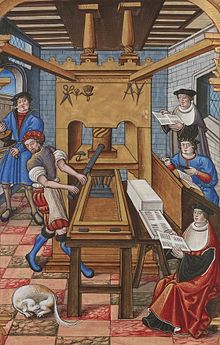
The first cast metal movable type was performed in Europe by mid-fifteenth century; was printed on paper with a press. The invention does not appear to bear some relation to previous Far East: both techniques are very different in terms of detail. While the eastern printers using water-soluble inks, Western inks used from the beginning diluted oils. In the East, the prints were achieved by simply pressing the paper with a piece of wood against the inked block. The first Westerners to the Rhine Valley printers using wooden mechanical presses whose design reminded me of wine presses. The eastern printers that used movable type bound them with mud or rods through rates.

Western printers developed a technique of casting types such precision that were held together by simple pressure applied to the ends of the support page. With this system, any letter stand out a fraction of a millimeter on the other, could make the letters around it ran out of print. The development of a method to melt letters with precise dimensions is the main contribution of Western invention.

The basics of printing had been used by European textile artisans to stamp tissues, at least a century before printing on paper was invented. The art of papermaking, who came to the West during the twelfth century, spread throughout Europe during the thirteenth and fourteenth centuries. By the mid-fifteenth century, already existed role in large quantities. During the Renaissance, the rise of a prosperous and enlightened middle class increased demand for written materials. The figure of Martin Luther and the Reformation and the subsequent religious wars, depended heavily on the press and the continuous flow of print.

Johann Gutenberg, born in Mainz (Germany), is traditionally considered the inventor of the printing press in the West. The date of this invention to 1450. Some Dutch and French historians have attributed this invention to his countrymen, claiming ample evidence. However, the books of the first printer of Mainz, and in particular the issue known as the Gutenberg Bible, far surpasses in beauty and expertise to all books that supposedly preceded him. The great achievement of Gutenberg undoubtedly contributed decisively to the immediate acceptance of the printed book as a substitute for handwritten book. Books printed before 1501 are said to belong to the era of incunabula.

In the period between 1450 and 1500 over 6,000 different works were printed. The number of printers increased rapidly during those years. In Italy, for example, the first printing press was founded in Venice in 1469, and by 1500 the city had 417 printers. In 1476 one Greek grammar is printed with fully Greek typography in Milan and in Soncino Hebrew Bible was printed in 1488. In 1476 William Caxton brought the printing press to England; in Spain, Arnaldo de Brocar composed the Complutense Polyglot Bible in six volumes between 1514 and 1517 at the initiative of Cardinal Cisneros; Juan Pablos in 1539 founded a printing press in Mexico City, introducing this technique in the New World. Stephen Day, a locksmith by trade, came to Massachusetts Bay in New England in 1628 and assisted in the founding of Cambridge Press.

Printers northern European manufactured especially religious books such as bibles, psalteries and missals. Italian printers, however, consisted mainly secular books, for example, the Greek and Roman classics recently rediscovered, stories of Italian writers lay and scientific works of the Renaissance scholars. One of the first major applications of printing was the publication of pamphlets: in religious and policies of the sixteenth and seventeenth centuries struggles, pamphlets circulated profusely. The production of these materials largely occupied printers of the time. The leaflets also had a wide circulation in the Spanish colonies in America in the second half of the eighteenth century.

miércoles, 14 de enero de 2015

100 years war 

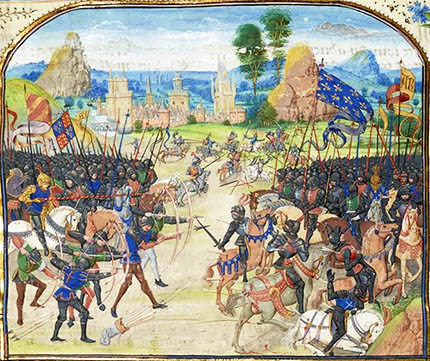
The Hundred Years' War was a protracted armed conflict that actually lasted 116 years (1337-1453) between the kings of France and England. This war was feudal roots, since its purpose was simply to settle who would control the vast possessions of the English monarchs in French territories since 1154, due to the ascent to the English throne of Henry Plantagenet, Count of Anjou and married Eleanor of Aquitaine. Had international implications. Finally, after countless avatars, ended with the British withdrawal from French soil.

The end of the war and the victory of France

The reforms and improvements made by Carlos VII paid off: French pressure slowly began to push back the enemy and was laying siege and retaking, step by step, all British possessions on French soil. Without the Burgundian support, the British had to deliver Normandy in 1450 and the precious Aquitaine in 1453.


sábado, 22 de noviembre de 2014

The noble warriors
Warrior Nobility : a privileged group .
 In feudal society , the main function of the nobility and the king himself , was to be warriors . They are the knights who were engaged in soldiering . Owning the equipment , horses and weapons were very expensive and only the feudal lords could perform that office .
  The sons of noble families were educated and trained as warriors. Were pages and then squires other gentlemen first.   At eighteen years were named knights in the inauguration ceremony in which they received their weapons : sword , shield and chainmail . From that moment, would be part of knighthood and should be courageous , loyal to his master and defend the weak and women.   The nobles waged war to defend their territory or ortho help the monarch or lord who owed ​​allegiance . The war provided if earned , land and wealth which enhanced the power of the nobility ( booty ) .   Their social function allowed the nobility live with privileges. They had to work , paid no taxes and were the only ones who could provide weapons and carry them control over the rest of the population.   Women , although they were of noble family , were subject to men , either the father or husband. They could inherit, and in the absence of men , to be holders of fiefs , but usually their marriage was acting in concert with nobles and their lands passed into the property of the husband's family .

sábado, 11 de octubre de 2014

Paula rojas sociales


Muhammad


Muhammad, in full Abū al-Qāsim Muḥammad ibn ʿAbd Allāh ibn ʿAbd al-Muṭṭalib ibn Hāshim   (born570, Mecca, Arabia, [now in Saudi Arabia]—died June 8, 632, Medina), founder of the religion of Islam, accepted by Muslims throughout the world as the last of the prophets of God.
Although his name is now invoked in reverence several billion times every day, Muhammad was the most-reviled figure in the history of the West from the 7th century until quite recent times. Because Muhammad is one of the most influential figures in history, his life, deeds, and thoughts have been debated by followers and opponents over the centuries, which makes a biography of him difficult to write. At every turn, both the Islamic understanding of Muhammad and the rationalist interpretation of him by Western scholars, which grew out of 18th- and 19th-century philosophies such as positivism, must be considered. Moreover, on the basis of both historical evidence and the Muslim understanding of Muhammad as the Prophet, a response must be fashioned to Christian polemical writings characterizing Muhammad as an apostate if not the Antichrist.


The 5 pilars of Islam
Profession of Faith:
This phrase: " There is no god but Allah and Muhammad is His Messenger " Should Be Made By Every Muslim Public At Least Once In Your Life , orally , and Feeling Great Being With A Member Power para de esta religion.


Prayer:

Five Times a Day should be praying, the first time before sunrise , The Second At Noon , The Third Between Cinco de la Tarde , The Fourth after sunset and the fifth and the last before bed and before midnight . You are self Five Performing On A Prayer Community In A Mosque Looking to the Kaaba , a cubic structure which is in the courtyard of Mecca. During Prayer Principle must be Foot THEN JOINS ago flexion Followed two prostrations And Finally sit .

Two Days In The regional annual festival , WHEN THE LAST First Month of Ramadan Fasting and The Other After The pilgrimage to Mecca , itself held in the morning followed Special Prayers sermons. Do not Sino ago in mosques especially in open spaces Dedicated one this type sentences .


The Alms :

Giving Alms Tax Is A Principle Of Muhammad paragraph Assist the Poor , and capture para Also converts to Islam , the Redemption of Captives of war, relief of Persons With Big Debts , Financing of jihad or " Holy War " and the Travel and Communications paragraph ease .


Fasting :

The other wears a Cape Fasting during the month of Ramadan. ALL THIS MONTH Durante , The People Have To refrain from eating , drinking , smoking and sexual relations from dawn until sunset also Have to feed at Least to the poor of the UN.


Pilgrimage :

It is the fifth and Obligation is to go on pilgrimage Kaaba So , as I said above IS in Mecca, should be performed at least once in the life of every Muslim. First Ten Days of the last month of the lunar year marks . Pilgrims must get dressed only with a white cloth and Have To abstain from bloodshed and cut your nails or hair. This pilgrimage is to give the Kaaba seven times , running between the two mounds Upcoming Sanctuary Other Sevenfold , Walking 3,827 kilometers to the mine , even after the 11,263 km Arafat , where The Evening Sermon Listen UN THEN returning to Mecca , Alli offer sacrifice Memorial UN attempt Abraham sacrificing his son and new They run around the Kaaba